Electre indisponible vendredi 06.07.2012

A partir de vendredi 6.7. matin, plusieurs systèmes d’authentification seront changés en cascade pour migrer  electre.com vers un nouveau modèle d’authentification.

Des interruptions d’accès sont possible à partir de 7h00 pendant toute la journée.

Avec nos excuses pour tout inconvénient.


New Mega Index available: Primo Central

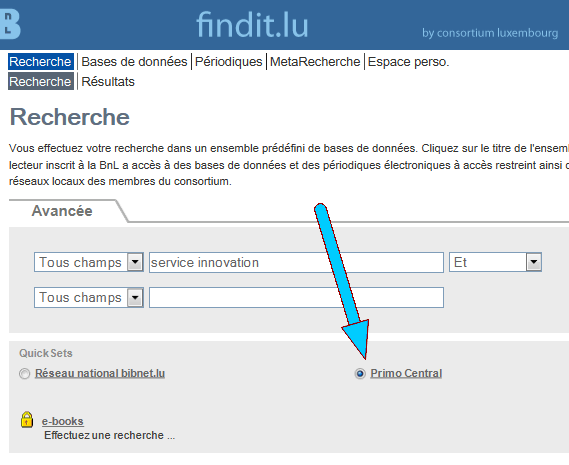
Try out the “Primo Central” Mega Index, select it and execute a query:
Primo Central is the next step in scholarly discovery tools: A single index which includes several hundred million references, abstracts and article full-text from a very large selection of publishers. Previously, only federated search allowed a simultaneous search of publications from different publishers. This functionality is called “Metasearch” in findit.lu (a guide is available). Additionally, you can save such a selection of resources for future searches in a “Quickset” (guide) and, building on that, even have findit.lu execute specific queries in these Quicksets as repeated “alerts” (guide).

While we will not abandon these features, there are some limitations in the concept of “Metasearch”. The most obvious is speed: the results can only be displayed once the slowest publisher has delivered. The second limitation is managing the result list, which can easily contain thousands of hits from different publishers. It is impossible, again for speed reasons, to download them all into findit.lu and then index them locally to allow for easy browsing, for instance by author, publication year, etc. Currently, findit.lu supports 30 to 50 results from each publisher, additional results are loaded on demand.

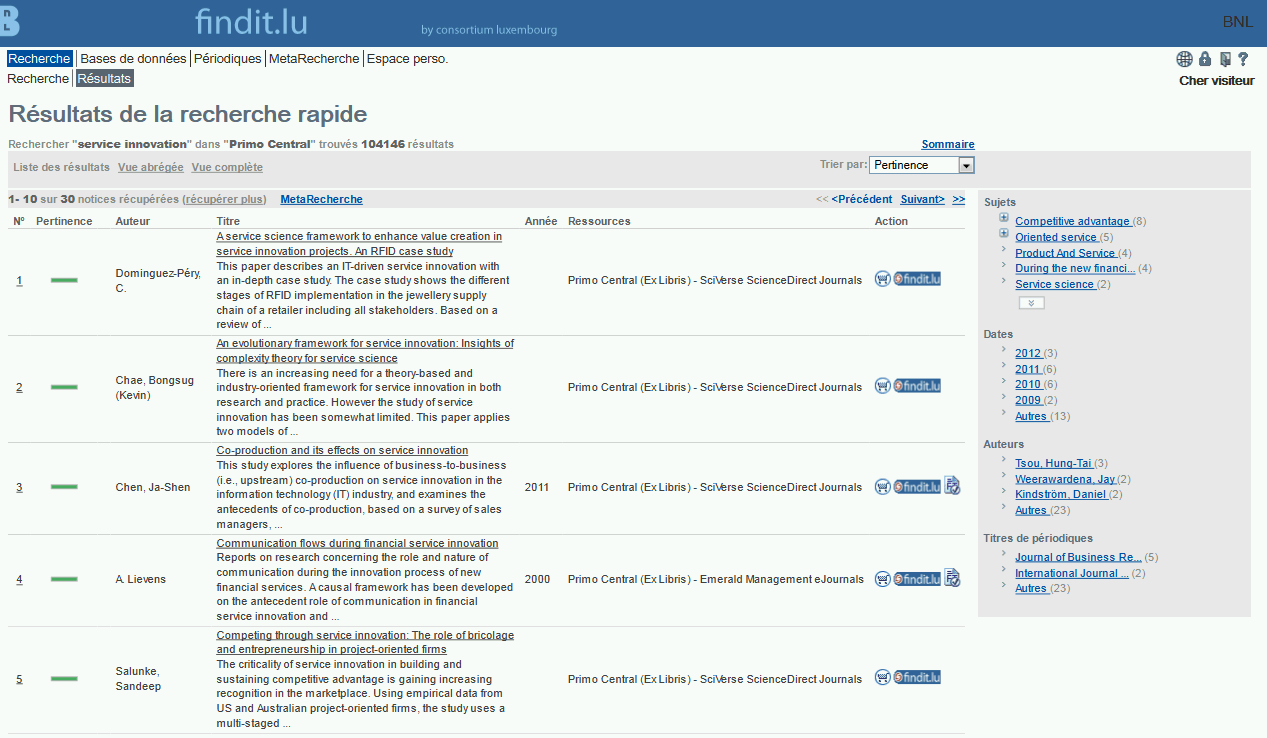
The new “Primo Central” mega index is a big step to solve these problems. It is an index that is pre-compiled fromreferences, abstracts and article full-text from a very large selection of publishers, overall it indexes sveral hundred million articles. This index is searchable in just one query, lightning fast and offers pre-compiled browsing of the results with facets, such as in the example screenshot below, a search for “service innovation”.

The current release is out of beta, fully functional, but not integrated yet with our subscriptions or print holdings. Stay tuned!
OECD iLibrary Youtube channel launched

The OECD iLibrary has launched a YouTube channel with several thematic videos, highlighting key reports from each OECD iLibrary theme. Below is a short video on the “Employment” theme:

The whole playlist contains seven videos on different themes.

The OECD iLibrary is groundbreaking in its inclusion of interactive statistics modules and data downloads straight from its reports, in various formats. Please check their english quick guide (pdf) or have a look at all the available user guides, including many different languages.

The OECD iLibrary is available via Consortium Luxembourg’s findit.lu portal. It is one of 38 databases available under the letter “O” in the databases list.

Connect directly via this link: OECD iLibrary. (Valid library card from the National library or University of Luxembourg required, more info under Help)


LexisNexis Jurisclasseur : fonctionalité indisponible

LexisNexis informe que dans l’onglet Jurisprudence, la recherche par type de juridiction ou sur une juridiction spécifique est actuellement indisponible.

Cela se traduit par l’apparition du message suivant :

message

LexisNexis travaille activement à la résolution de ce problème applicatif qui devrait être résolu dès lundi matin.

Dans l’intervalle, LexisNexis conseille de laisser la case ‘Toutes les juridictions’ cochée par défaut pour vos recherches en Jurisprudence.

The Economist on Open Access mandates

“PUBLISHING obscure academic journals is that rare thing in the media industry: a licence to print money. An annual subscription to Tetrahedron, a chemistry journal, will cost your university library $20,269; a year of the Journal of Mathematical Sciences will set you back $20,100. In 2011 Elsevier, the biggest academic-journal publisher, made a profit of £768m ($1.2 billion) on revenues of £2.1 billion. Such margins (37%, up from 36% in 2010) are possible because the journals’ content is largely provided free by researchers, and the academics who peer-review their papers are usually unpaid volunteers. The journals are then sold to the very universities that provide the free content and labour. For publicly funded research, the result is that the academics and taxpayers who were responsible for its creation have to pay to read it. This is not merely absurd and unjust; it also hampers education and research.”
Continue reading  online  or in the Economist’s print edition from 14th April.

Elsevier available again

For reasons which are still being investigated, our Elsevier access was cut, impacting the ScienceDirect, Sciverse and Scopus products. Access has been restored as of 14h today.

Apologies for any inconvenience.


Elsevier available again

For reasons which are still being investigated, our Elsevier access was cut, impacting the ScienceDirect, Sciverse and Scopus products. Access has been restored as of 14h today.

Apologies for any inconvenience.


Elsevier available again

For reasons which are still being investigated, our Elsevier access was cut, impacting the ScienceDirect, Sciverse and Scopus products. Access has been restored as of 14h today.

Apologies for any inconvenience.