Month: August 2013

ProQuest implements CAPTCHAs

Some days ago, ProQuest implemented CAPTCHAs because they have detected bots attempting to download information from their databases without permission. Using CAPTCHA will help protect the rights of copyright holders by ensuring that information is accessed only by authorized users.
Please find below some FAQs concerning CAPTCHAs in ProQuest Databases:

What is a CAPTCHA?
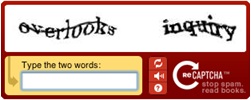
A CAPTCHA (or Completely Automated Public Turing test to tell Computers and Humans Apart) is used to detect if activity is coming from a “real” human – not from an automated script, commonly referred to as a bot.

Example CAPTCHA:


Why has Proquest introduced the use of CAPTCHAs?
We have introduced CAPTCHAs because, like many other online services, we’ve detected bots attempting to download copyrighted information.

Which products do the CAPTCHAs impact?
This will apply to all databases on the ProQuest platform (e.g Factiva, ProQuest Central, ProQuest Dissertations and Theses, etc.).

When will ProQuest users see CAPTCHAs?
We have analyzed usage on the platform and picked a usage threshold for CAPTCHAs that is designed to minimize the impact for our users. We anticipate that the vast majority of users will not see CAPTCHA prompts, and these will occur in a very small percentage of users’ research sessions.

Can customers follow links to our content without entering a CAPTCHA?
Customers following links to access some content types may see CAPTCHAs immediately. For example, a user following a direct link to a document stored in a browser bookmark may see a CAPTCHA before being able to access the document. Likewise, a customer accessing content via Summon, direct links in a Learning Management System, or an email alert may be required to enter a CAPTCHA before viewing documents.

Is this a permanent measure?
Data security is continually evolving, and ProQuest is always looking for better ways to enhance the security of our services. At this stage, the use of a CAPTCHA has been identified as an effective security method. We will continue to evaluate additional security enhancements.

Are CAPTCHAs accessible for the visually impaired?
Yes. We are using Google Technology to generate our CAPTCHAs. More information on accessibility is available here.
DUDEN auf MUNZINGER Online: “Die deutsche Rechtschreibung” – 26. Auflage

Wir freuen uns, mitteilen zu können, dass seit einigen Tagen die komplett überarbeitete 26. Auflage des DUDEN-Standardwerks „Die deutsche Rechtschreibung“ auf Munzinger Online verfügbar ist. In der neuen Auflage, auf die wir bereits Zugriff haben, finden sich ca. 5000 neue Wörter von der Arabellion über den Shitstorm bis hin zum Vollpfosten. Mit dieser Aktualisierung des Wortschatzes bewegen Sie sich im Wandel der Gegenwartssprache stets auf der sicheren Seite. Die bewährten gelben Hervorhebungen empfohlener DUDEN-Schreibweisen bei mehreren richtigen Möglichkeiten wurden selbstverständlich beibehalten.

Der Wortschatz hat sich in den letzten Jahren weiterentwickelt. Wer auf dem aktuellen Stand der Sprache sein und alle neuen Wörter richtig schreiben will, braucht den neuen Duden.

Die neue Ausgabe des Duden lässt sich hier durchsuchen: http://www.munzinger.de.proxy.bnl.lu/search/query?query.id=query-duden
Zudem findet sich der “Duden” in der Liste der Datenbanken auf findit.lu unter dem Buchstaben “D”.

Login problem resolved

Some users had trouble logging in during the last three days. This was due to a configuration problem of the Proxy server which is handling authentification. The issue has been resolved now and all systems are back to normal. Apologies for any inconvenience caused.
Have a great weekend!

A whole new look for zbMATH is now online!

zbMATH, formerly Zentralblatt MATH, is a comprehensive source of bibliographic data, reviews and abstracts from all areas of pure and applied mathematics as well as its applications, in particular to the natural sciences, computer science, economics and engineering. It also covers history and philosophy of mathematics and university education.

The new zbMATH has now been online for a few days – featuring a new layout and innovative search functions. Since June zbMATH has offered a much clearer look and feel, coupled with additional search functions.

zbMATH – the facts:

  • The new, easier-to-use search function rapidly delivers precise results for documents, authors, journals etc.
  • The new filter function analyzes results in real-time, helping users to further refine their search terms and successfully carry out complex searches.
  • Includes the integrated swMATH-database – a key feature for users searching for mathematics software.
  • More than 3 million indexed entries from over 3,500 journals, 1,100 series and 170,000 books from 1868 to the present.
  • Daily updating and more than 120,000 new entries every year.
  • Reviewed by more than 7,000 experts from around the globe.

zbMATH offers an essential tool for mathematicians working at academic institutes, and for all others who use mathematics in their careers.

You can access zbMATH via findit.lu inside the buildings of National Library and University of Luxembourg by selecting the letter “Z” via the “Find databases” tab.

Free access Oldenbourg Wissenschaftsverlag

In August, de Gruyter offers free and unlimited online access to publications from Oldenbourg Wissenschaftsverlag  and Akademie Verlag. Hurry up – free access is only available until August 31, 2013!
All titles available from Oldenbourg Wissenschaftsverlag can be found here.

With its history of more than 150 years, the Oldenbourg Wissenschaftsverlag is amongst the long established companies in the publishing industry. It offers a variety of books and journals, cross-media and electronic products as well as services for science, practitioners and learning.

The Oldenbourg Wissenschaftsverlag supports researchers and scientific organisations, interested academics in employment and further education as well as students and lecturers of all institutions of higher education in their professional life and in all learning situations. The range of products and services covers business/economics and social sciences, humanities including history, philosophy and linguistics, and natural sciences and engineering as well as information technology.