New content

Journal of Innovation Management – The International Journal on Multidisciplinary Approaches on Innovation

Dr. Anne-Laure Mention, head of the Innovation Economics & Service Valuation unit, at the CRP Henri Tudor, is co-editor of the Journal of Innovation Management.

The Journal of Innovation Management adopts a multidisciplinary perspective on innovation. In doing this, it fills an existing gap by hosting visionary and eloquent research streams enabling the understanding of innovation, appreciating differentiation and striving for academic excellence and insights for practice. The Journal aims at paving new ways of fostering innovation and at bridging the gaps between the different communities involved in the definition of innovation policies, in the analysis of the innovation process and its multiple outcomes, and in its implementation in both public and private entities. It brings the reality of innovation at hand by fostering a philosophy of true innovation management by encapsulating insights, valuable experiences and theoretical streams. With this initiative, the Founding Editors aim at creating a new “Blue Ocean” and at reconfiguring the publishing “arena” by combining the best of both worlds while adopting simultaneously a visionary approach on innovation management and the current shift occurring in the business model of publishing practices.

Furthermore, the Journal of Innovation Management aims at hosting the debate for innovation, whatever form and facet it takes, and its management. Particular attention is paid to the multidisciplinary nature of the innovation, thus embracing both its technological features and its managerial process. Issues of the journal will typically contain academic papers, letters from industry thought leaders, academics, and policy makers, book reviews and commentaries. Four issues per year will be released, and some special issues are also foreseen, so as to concentrate on dedicated themes, which will be addressed from multiple angles. The ultimate aims are to foster cross fertilization across disciplines, to bridge gaps between academia, practice and policy making, to raise awareness on innovation and entrepreneurship, its challenges and its impact as well as to shape new reflections and thoughts on innovation, and its management. A broad scope of readership in innovation and entrepreneurship is expected. With its full open access policy, the Journal of Innovation Management is a platform for exchanging ideas in both horizontal and vertical dimensions of innovation management. The idea is to publish topical research works, practitioners’ insights and case studies on innovation with true multidisciplinary flavor.

The 3rd issue is forthcoming and should be available during the Summer.

To read issue 1 and 2, please visit www.open-jim.org

Emerald: A celebration of football

Logo Emerald PublishingEmerald is kicking off the football frenzy and is offering a selection of football-related research articles from the Emerald Management eJournals Database.

As the world’s focus turns to Brazil, these insightful articles offer a different perspective on what it means to host a ‘mega’ event, both from a business and supporter perspective, covering topics related to economics, tourism and hospitality, marketing and branding.

Read now
An overview of the influences of climate conditions on the FIFA 2014 World Cup in Brazil
Walter Leal Filho (2014), International Journal of Climate Change Strategies and Management
One element which has largely been overlooked in the preparations for the 2014 FIFA World Cup is the connection between climate change, variable climate conditions and their impacts on the performance of players.

Go to http://www.emeraldgrouppublishing.com/rin/worldcup.htm to view all articles on the Emerald website dealing with lessons from football/sports events or fan’s involvement.

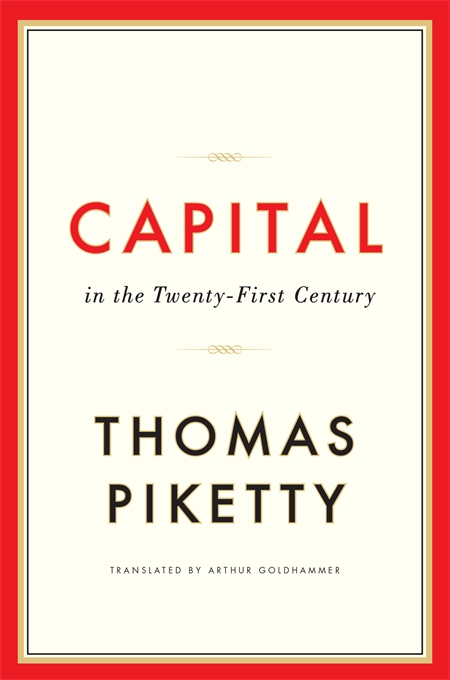
Thomas Piketty’s “Capital in the Twenty-first Century” available via findit.lu

Front Cover Capital in the Twenty-First CenturyWhat are the grand dynamics that drive the accumulation and distribution of capital? Questions about the long-term evolution of inequality, the concentration of wealth, and the prospects for economic growth lie at the heart of political economy. But satisfactory answers have been hard to find for lack of adequate data and clear guiding theories. In Capital in the Twenty-First Century, Thomas Piketty analyzes a unique collection of data from twenty countries, ranging as far back as the eighteenth century, to uncover key economic and social patterns. His findings will transform debate and set the agenda for the next generation of thought about wealth and inequality.

Piketty shows that modern economic growth and the diffusion of knowledge have allowed us to avoid inequalities on the apocalyptic scale predicted by Karl Marx. But we have not modified the deep structures of capital and inequality as much as we thought in the optimistic decades following World War II. The main driver of inequality—the tendency of returns on capital to exceed the rate of economic growth—today threatens to generate extreme inequalities that stir discontent and undermine democratic values. But economic trends are not acts of God. Political action has curbed dangerous inequalities in the past, Piketty says, and may do so again.

A work of extraordinary ambition, originality, and rigor, Capital in the Twenty-First Century reorients our understanding of economic history and confronts us with sobering lessons for today.

Source: Harvard University Press

“Capital in the Twenty-First Century” is now available via findit.lu as an ebook! Simply go to www.findit.lu – Find Databases – Letter “E” and choose EBSCO eBook Collection (ecm) to find this ebook below other titles chosen by our librarians.

Direct link to “Capital in the Twenty-First Century”

Codecademy – Learn to code interactively, for free.

codecademy logoCodecademy helps millions of learners around the world get the skills they need to succeed in today’s digital world — all in a way that’s fun, free, and accessible anywhere. Codecademy offers an entirely new, networked approach to learning in which you interact with students across the globe, build amazing projects, and – most important – apply your skills to improve your life.

How it works
Codecademy is different from any other learning experience; it’s designed to complement the way people want to learn in the twenty-first century. On Codecademy, learners discover concepts by actually building things and getting constant feedback from peers. Learning and demonstrating skills become one and the same – and students are always left with something tangible to show for their efforts. The community of millions of learners is at the ready to help everyone achieve the outcome they want, through study groups, question and answer forums, and more.

Courses for following computer languages are offered at the moment:

Life-changing knowledge should be free and easily accessible to anyone, and on Codecademy it is, with thousands of courses available for free online and yet more available for users on the mobile apps for iPhone and iPad. Most of all, Codecademy‘s students have access to one another, as well as the tools they need to make each other smarter, more skilled, and more productive.

Codecademy can be accessed by selecting the letter “C” via the “Find databases” on findit.lu. There is also a direct link: Codecademy

The Bluebook Online

The BluebookWe are happy to announce that we’re now offering online access to the The Bluebook Online .

The Bluebook is the definitive style guide for legal citation in the United States. For generations, law students, lawyers, scholars, judges, and other legal professionals have relied on The Bluebook’s unique system of citation. In a diverse and rapidly changing legal profession, The Bluebook continues to provide a systematic method by which members of the profession communicate important information about the sources and authorities upon which they rely in their work.

The Bluebook can be accessed by selecting the letter “B” via the “Find databases” tab or in the journal’s list on findit.lu.There is also a direct link: The Bluebook  

Since there is a limit of 5 concurrent users (“5 parallel seats”), please use the “Release Seat” button as soon as you’ve finished your research to allow other users to access the site. This button is located in the top right corner of the page.

New content: Facet Publishing eBooks

Facet-Publishing-logoConsortium Luxembourg is happy to announce that we are now offering access to a selection of Facet Publishing eBooks.
Facet Publishing, the commercial publishing and bookselling arm of CILIP: the Chartered Institute of Library and Information Professionals, is the leading publisher of books for library and information professionals worldwide.

As a start, we purchased 41 eBooks all dealing with aspects of librarianship, library management, electronic libraries, archives, etc.
Download the complete titlelist (pdf) here.

The eBooks can be accessed via the Ebsco eBook collection platform. You may search and read the books online, but also download and borrow the books for a limited time (maximum 7 days) and transfer them to a portable device.

Attention: if you want to download an eBook, it is necessary to create a free My EBSCOhost account and download Adobe Digital Editions (incl creating an Adobe-ID). If you want to search books or read them online, no additional software or login is required.
Need help?
Ebsco eBooks Guide in English
Ebsco eBooks Guide d’Utilisation en français

All titles can be found in our eBook search on findit.lu. Our Ebsco eBook collection can also be found by selecting the letter “E” via the “Find databases” tab.


Click here to access our Facet Publishing eBooks directly.

If you need any support, please send an e-mail to help@findit.lu

Encyclopédie médico-chirurgicale (EMC) en ligne

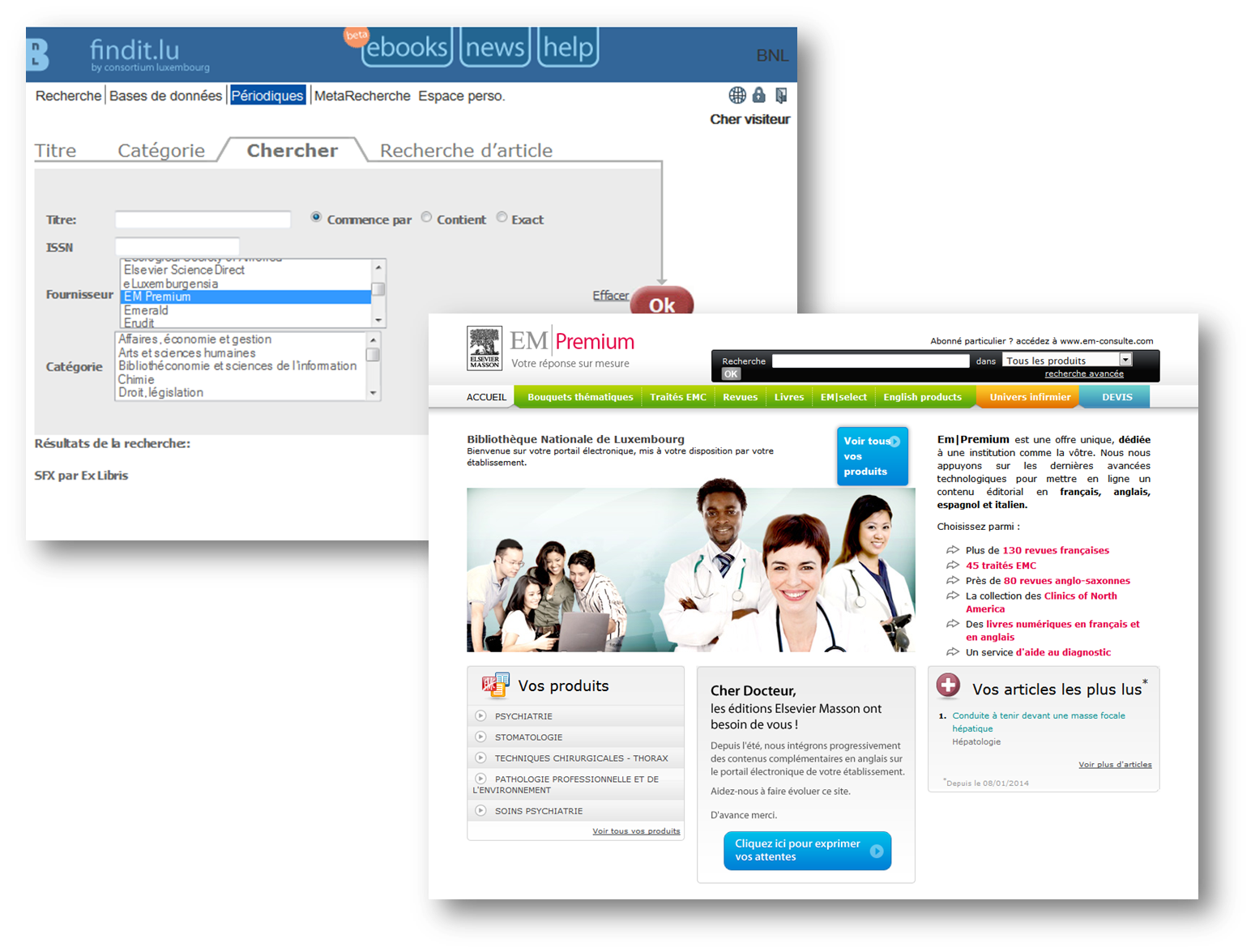
Logo EM PremiumLes traités EMC (Encyclopédies médico-chirurgicales) sont à présent disponibles via findit.lu (accès à distance) à partir de la plateforme EM-Premium.
Largement reconnue comme référence dans toutes les spécialités médicales et paramédicales, l’EMC rassemble des articles rédigés par les plus grandes signatures. Réactualisé en continu grâce à des mises à jour régulières, elle ne laisse de côté aucune problématique, aucune technique de pointe ayant fait l’objet d’un consensus, ni aucune pathologie…
Les habitudes des lecteurs et les Technologies évoluent, l’EMC également. Tous les traités EMC sont accessibles à partir du site http://www.em-premium.com.proxy.bnl.lu/.
Ils disposent ainsi de tous les avantages offerts par Internet:

  • Des autoévaluations, des compléments multimédia (vidéos, iconographies supplémentaires…)
  • La recherche rapide, la mise à jour automatique, l’archivage des articles, des alertes

A quoi avez-vous accès ?
Tous les utilisateurs de findit.lu ont accès aux ressources suivantes :

  • Les traités de l’Encyclopédie médico-chirurgicale
  • Une sélection de revues parmi l’ensemble de l’offre d’Elsevier Masson. Les titres accessibles sont surlignés en vert.

EM Premium est disponible sur findit.lu dans l’onglet “Base de données” sous la lettre “E” ou en cliquant ici. Vous trouverez tous les traités EMC également dans la liste des périodiques (Périodiques > Chercher > Fournisseur « EM Premium »).

Portail EM Premium


The Philosopher’s Index – A Superior Bibliographic Database Covering Scholarly Research in all Major Fields of Philosophy

We are happy to announce that we’re now offering online access to the Philosopher’s Index.

Produced by the Philosopher’s Information Center, this current and comprehensive bibliographic database covers scholarly research in all major fields of philosophy. Considered the most thorough index of journal literature on the subject, this resource features author-written abstracts covering scholarly research published in journals and books, including contributions to anthologies and book reviews.
Access to the finest scholarly resources for philosophers and those interested in related disciplines

The Philosopher’s Index contains research published since 1940 and includes more than 500,000 records.  With more than 1,500 journal titles from over 450 different publishers, the database covers all fields of philosophy, including aesthetics, axiology, philosophy of education, epistemology, ethics, philosophy of history, philosophy of language, logic, metaphysics, philosophical anthropology, meta-philosophy, political philosophy, philosophy of science, social philosophy, and the philosophy of religion. The publications covered in this comprehensive database hail from 139 countries and appear in 37 languages.

Subjects Include:

  • Aesthetics
  • Axiology
  • Epistemology
  • Ethics
  • Logic
  • Meta-philosophy
  • Metaphysics
  • Philosophical Anthropology
  • Philosophy of Education
  • Philosophy of History
  • Philosophy of Language
  • Philosophy of Religion
  • Philosophy of Science
  • Political Philosophy
  • Social Philosophy

The Philosopher’s Index can be accessed by selecting the letter “P” via the “Find databases” tab on findit.lu. There is also a direct link: Philosopher’s Index.

New content:Taylor & Francis – Social Science and Humanities Library

Taylor-Francis-Online-LogoConsortium Luxembourg is happy to announce that we are now offering access to the complete Taylor & Francis Social Science & Humanities Library for students and staff of the University of Luxembourg.

The T&F Social Science & Humanities Library provides online access to a broad range of journal content in 14 subject areas. Taylor & Francis Group is the largest global publisher in the Social Science Edition of the recently-released 2012 Thomson Reuters Journal Citation Reports (JCR)®.

The Taylor & Francis Social Science & Humanities Library delivers essential content in the following areas:

  • Anthropology & Archaeology
  • Arts & Humanities
  • Behavioral Science
  • Business, Management & Economics
  • Criminology & Law
  • Education
  • Geography, Planning, Urban & Environment
  • Health & Social Care
  • Library & Information Science
  • Media, Cultural & Communication Studies
  • Politics, International Relations & Area Studies
  • Sociology & Related Disciplines
  • Sport, Leisure & Tourism
  • Strategic, Defence & Security Studies

Please note that the Social Science and Humanities Collection can only be accessed inside the buildings the University of Luxembourg.
All titles can be found in our eJournal search on findit.lu. The Taylor & Francis Social Science & Humanities Library can also be found by selecting the letter “T” via the “Find databases” tab. There is also a direct link: www.tandfonline.com.

If you have any questions please check findit.lu/start and findit.lu/faq or send us en email at help@findit.lu.

A whole new look for zbMATH is now online!

zbMATH, formerly Zentralblatt MATH, is a comprehensive source of bibliographic data, reviews and abstracts from all areas of pure and applied mathematics as well as its applications, in particular to the natural sciences, computer science, economics and engineering. It also covers history and philosophy of mathematics and university education.

The new zbMATH has now been online for a few days – featuring a new layout and innovative search functions. Since June zbMATH has offered a much clearer look and feel, coupled with additional search functions.

zbMATH – the facts:

  • The new, easier-to-use search function rapidly delivers precise results for documents, authors, journals etc.
  • The new filter function analyzes results in real-time, helping users to further refine their search terms and successfully carry out complex searches.
  • Includes the integrated swMATH-database – a key feature for users searching for mathematics software.
  • More than 3 million indexed entries from over 3,500 journals, 1,100 series and 170,000 books from 1868 to the present.
  • Daily updating and more than 120,000 new entries every year.
  • Reviewed by more than 7,000 experts from around the globe.

zbMATH offers an essential tool for mathematicians working at academic institutes, and for all others who use mathematics in their careers.

You can access zbMATH via findit.lu inside the buildings of National Library and University of Luxembourg by selecting the letter “Z” via the “Find databases” tab.